
First Principles Thinking in the AI era
AI is changing everything. Fast.

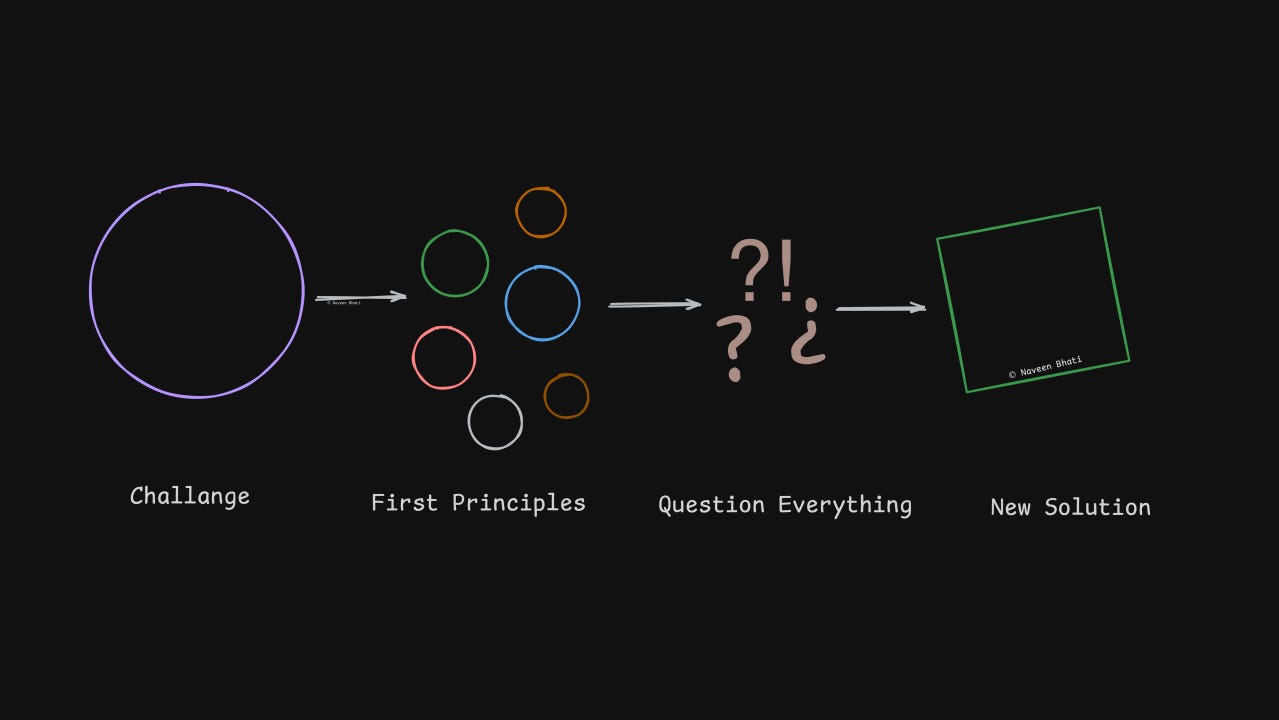
AI is changing everything. Fast.
It's hard to keep up. What works today might not work tomorrow. But there's a solution: first principles thinking.
Imagine you're building with LEGO bricks.
You could follow the instruction manual. That's how most people think - following existing patterns and solutions.
Or you could dump all the bricks on the table and ask: "What could I build from scratch?"
That's first principles thinking. You:
Break things down to their simplest parts (the basic LEGO bricks)
Question why things are done a certain way
Build up your own solution
It's like being a curious child who keeps asking "Why?"
Why do we do it this way?
What's actually happening here?
What if we started over?
Why It Matters Now
Tech moves quickly. AI moves even quicker. Yesterday's solutions often don't solve today's problems. We need a better way to think.
First principles thinking is that better way. It helps you:
Understand problems deeply
Question old habits
Build fresh solutions
Stay ahead of change
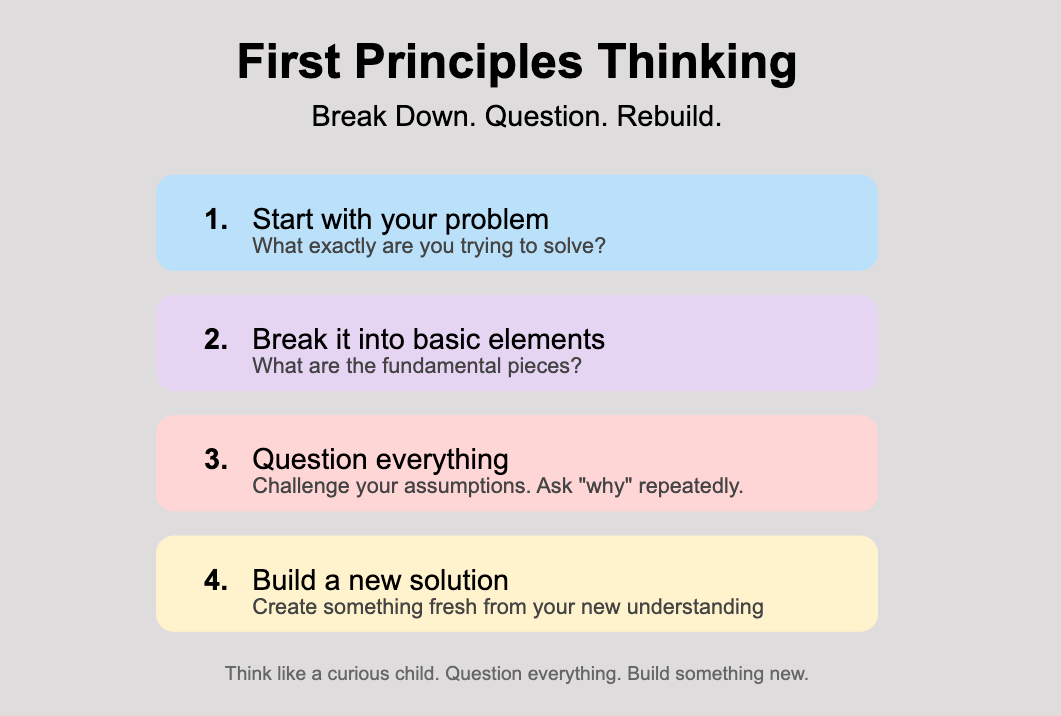
The Four-Step Process for First Principles Problem-Solving
Problem Identification
Data requirements and quality
Computing infrastructure needs
User interface considerations
Ethical implications
Security requirements
Integration points with existing systems
Challenging Assumptions
"More data always leads to better results"
"Complex models are always more effective than simple ones"
"AI must replicate human decision-making processes"
"Existing solutions are the best starting point"
Building New Solutions
Practical Applications in AI Development
First principles thinking has already led to significant breakthroughs in AI development:
Architecture Innovation: Instead of incrementally improving existing neural network architectures, researchers using first principles thinking have created entirely new approaches like transformers and attention mechanisms.
Resource Optimisation: By questioning basic assumptions about compute requirements, teams have developed more efficient training methods and lighter model architectures.
Problem Formulation: Breaking down complex tasks into fundamental components has led to more effective ways of structuring AI problems, leading to better results with less data and compute power.
Challenges and Considerations
While powerful, first principles thinking comes with its own challenges:
Time Investment: Breaking everything down to fundamentals requires significant initial time investment.
Expertise Balance: You need enough domain knowledge to identify true fundamentals while remaining open to questioning established practices.
Scope Management: Not every problem requires a first-principles approach; knowing when to apply it is crucial.
Implementation Strategy
To effectively use first principles thinking in AI and tech:
Start Small: Practice with well-defined, contained problems before tackling larger challenges.
Document Everything: Record your assumptions, breakdowns, and reasoning process.
Create Feedback Loops: Regularly test your solutions against real-world conditions.
Build a Learning Culture: Encourage questioning and exploration within your team.
Stay Current: Maintain awareness of new developments while remaining willing to question them.
Looking Forward
As AI continues to evolve, first principles thinking becomes increasingly valuable. It helps us:
Navigate uncertainty in rapidly changing fields
Identify genuine opportunities among the hype
Develop more robust and innovative solutions
Address fundamental challenges rather than symptoms
The true power of first principles thinking lies not just in solving today's problems, but in building the mental models and approaches needed to tackle tomorrow's challenges.
Remember
The goal isn't to reinvent everything, but to understand deeply enough to know where innovation is truly needed and where existing solutions suffice.